Buying the wrong cement transport unit can cause slow discharge, high residue, axle overload, and costly downtime. These problems grow when buyers compare only cubic capacity. The safer approach is to match the tank, chassis, compressor, and discharge system to the powder, route, and local rules.
A remolque cisterna para cemento a granel is a sealed dry bulk vehicle that carries loose cement, lime, fly ash, and similar powders. It uses compressed air to fluidize the material and move it through a discharge pipe into a storage silo. The right model depends on tank volume, material density, axle limits, road conditions, compressor output, and unloading requirements.

Esquema del artículo
- What is a cement tanker and how does it work?
- Which dry bulk materials can it carry?
- What tank shape is best for bulk cement transport?
- How much capacity should a buyer choose?
- How do pneumatic loading and unloading systems work?
- Which chassis, axle, and material options matter?
- What safety features and quality checks should buyers review
- How do small-cube and large-cube designs differ?
- What affects cement trailer price?
- Preguntas frecuentes
What Is a Cement Tanker and How Does It Work?
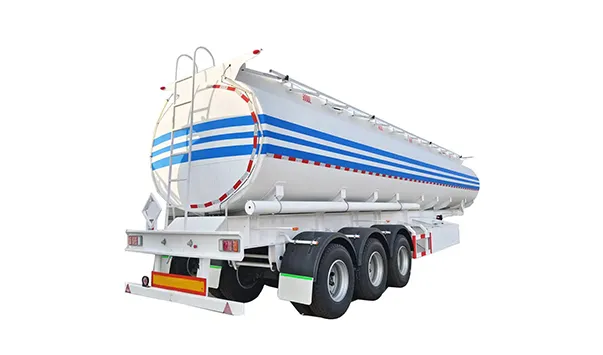
A cement tanker is a sealed semi trailer built for dry bulk transportation. It is also called a cement bulker trailer, silo semi trailer, powder tanker, or silobas in some supplier markets. The unit does not carry wet concrete. It carries fine, dry powder from a cement plant or terminal to a silo at a batching plant, construction site, mine, or industrial facility.
Cement itself is a finely ground powder used as a binding ingredient in concrete and mortar. A cement mixer carries wet concrete, while a bulker carries the dry ingredient before water and aggregates are added.
The operating idea is simple. A diesel engine or another power source drives an air compressor. Compressed air enters the powder tank through an aeration system. The air helps the material flow, and pressure pushes it through the lower outlet, pipe, and hose.
This process supports enclosed bulk transport and avoids handling hundreds of separate bags. It can also reduce dust exposure and speed up delivery when the receiving site has a suitable storage silo.
CHENLU’s current category page presents V-shaped and W-shaped models with an air compressor and diesel engine, commonly customized from 30 to 60 cubic meters. The current model pages also show a 40CBM product direction, but their detailed capacity statements conflict. The final figure should therefore be confirmed in the approved technical sheet.
Which Dry Bulk Materials Can the Trailer Carry?
The main cargo is dry bulk cement, but the same general equipment family may also move lime powder, fly ash, mineral powder, and selected granular products. The exact material must be confirmed because particle size, density, moisture, abrasiveness, and contamination risk affect the design.
A unit used for construction powder should not automatically be treated as a food-grade trailer. Food-grade hauling requires different materials, surface finishes, cleaning standards, valves, seals, and contamination controls. Likewise, a vehicle designed for sand and cement may need greater abrasion protection than one used for a light industrial powder.
Before production, buyers should provide:
- Exact material name
- Bulk density
- Moisture content
- Particle size
- Loading temperature
- Required discharge height
- Expected unloading time
- Cleaning requirements
- Whether cross-contamination is acceptable
This information helps the manufacturer select the correct powder tank, aeration layout, pipe diameter, and compressor configuration. It also prevents one design from being used for the wrong bulk materials.
A powder tanker trailer can offer useful versatility, but only when the different products have compatible cleaning, sealing, and discharge needs. A vehicle should never switch between construction powder and sensitive food products without a proper contamination-control plan.
What Tank Shape Is Best for Bulk Cement Transport?
Most CHENLU models use a V shape or W-shaped tank. These forms guide powder toward the lower discharge points. Gravity starts the movement, while compressed air completes the transfer.
Tank geometry also affects:
- Residual material
- Center of gravity
- Longitud total
- Number of discharge cones
- Air distribution
- Internal cleaning
- Chassis layout
A V-shaped design often provides a simple and direct flow path. A W-shaped layout may divide the lower part of the vessel into more discharge areas. Neither shape is automatically better.
The correct choice depends on cubic capacity, chassis length, powder behavior, hose routing, and the receiving silo. A smooth-looking vessel can still unload poorly if the aeration pads, cones, valves, and pipe routing do not work together.
Some buyers search for a “shape cement tanker,” but the more useful question is:
How well does the tank geometry match the material and pneumatic system?
CHENLU publicly promotes V-shaped y W-shaped structures for cement, lime, and other powder cargo. The company also states that its current 40CBM page uses an optimized discharge layout, although its published unloading time should be treated as a product-page claim rather than a guaranteed result.
How Much Dry Bulk Trailer Capacity Do You Need?
Capacity may be stated in cubic meters or cubic feet, but volume alone does not tell you how many tons the vehicle can legally haul. The final payload depends on:
- Material bulk density
- Vehicle tare weight
- Peso del tractor
- Límites del eje
- Clasificaciones de llantas
- Gross combination limits
- Route regulations
A basic planning formula is:
Estimated material weight = usable tank volume × bulk density
This is only an early estimate. The legal payload may be lower because of chassis weight, axle spacing, the tractor configuration, and road rules.
| Necesidad operativa |
Possible Capacity Direction |
Main Check |
| Regional cement delivery |
30–35 m³ |
Site access and trip frequency |
| Standard construction supply |
Around 40 m³ |
Legal payload and axle load |
| Long-distance high-volume work |
45–60 m³ |
Gross weight and tractor match |
| Low-density powder |
Large cube |
Volume limit before weight limit |
| Dense or abrasive material |
Small cube |
Structure and legal payload |
CHENLU’s category-level public range is 30–60 m³. However, one current page also contains 30–70CBM, 35–40CBM, and 40CBM statements. A buyer should not rely on the page title alone.
The confirmed purchase specification should clearly state:
- Gross tank volume
- Usable volume
- Intended material density
- Carga útil legal
- Tank tare weight
- Disposición de los ejes
- Requisitos del tractor
A larger tank is not always more efficient. If local laws limit axle weight, the fleet may fill the vessel only partly. In that case, extra volume adds cost and weight without increasing legal cargo.

How Do Pneumatic Loading and Unloading Systems Work?
A pneumatic system uses compressed air to make dry powder flow through pipes. Loading usually takes place from a plant silo or loading station through top inlets.
During discharge, the compressor supplies air to the tank and aeration system. The material becomes easier to move and then flows through the lower valve, pipe, and hose into the customer’s storage silo.
The main components normally include:
- Diesel engine or other power source
- Air compressor
- Air lines
- Aeration pads
- Pressure gauge
- Relief device
- Válvula de descarga
- Discharge pipe
- Flexible hose
- Manholes
- Dust-control connections
CHENLU’s current public table lists a Weichai 4102 engine and a Bohai compressor rated at 12CBM/min for the displayed model. These are product-page specifications, not universal equipment for every dry bulk trailer.
The same page says a 40CBM load can discharge in about 26 minutes. Actual performance may change because of:
- Powder moisture
- Material condition
- Operating pressure
- Hose length
- Pipe diameter
- Number of pipe bends
- Receiving-silo height
- Compressor condition
- Operator practice
A serious quotation should define the test material and site conditions before promising a discharge time.
Efficient loading and unloading also depends on the receiving facility. A good vehicle can still perform poorly if the silo pipe is too narrow, the connection leaks, the filter is blocked, or the hose is unusually long.
Which Chassis, Axle, and Material Options Matter?
The tank and chassis must function as one structure. CHENLU’s current product information describes a T700 high-strength chassis and lists carbon steel or aluminum as possible material directions. The same page also refers to high-strength manganese steel, so the final material grade must be confirmed rather than combined from several template statements.
The shared public specification table lists 2-, 3-, and 4-axle options with 13T or 16T axle directions. A 3 axle configuration is common in many markets, but it is not automatically correct for every country.
The final layout depends on:
- Legal vehicle weight
- Capacidad del tanque
- Material density
- Tractor configuration
- Tipo de suspensión
- Tire load rating
- Calidad de las carreteras
- Espacio de giro
- Bridge restrictions
Important engineering points include:
- Tank-shell thickness
- Dish-end thickness
- Chassis material
- Cross-member layout
- Tank support saddles
- Axle position and spacing
- Suspensión mecánica o neumática
- Tire and rim rating
- Kingpin position
- Landing gear capacity
- Sistemas de frenos y eléctricos
Buyers may choose aluminum or steel, but the decision should follow the cargo, local repair capability, tare-weight target, corrosion exposure, and purchase budget.
The Dominican Republic case describes a 3-axle unit with an optimized pneumatic system and a reported 10mm tank body. That figure conflicts with the generic product table, which lists 4/5mm body and 5/6mm dish-end options. The 10mm value must therefore remain case-specific unless production records confirm otherwise.

What Safety Features and Quality Checks Should Buyers Review?
Dry powder is not a liquid, but the equipment operates under pressure during unloading. Buyers should review the pressure-rated components, relief devices, manholes, valves, pipe supports, ladders, walkway, guards, brake system, and operating instructions.
Important safety features and checks include:
- Material certificate review
- Tank-thickness verification
- Weld inspection
- Pressure test
- Leak test
- Relief-device inspection
- Valve operation test
- Compressor test
- Pipe and hose inspection
- Brake and lighting test
- Axle-alignment check
- Ladder and walkway inspection
- Final dimensional inspection
CHENLU describe un proceso de fabricación de siete etapas:
1. Preparación del material
2. Soldadura con viga principal
3. Montaje del armazón
4. Tratamiento de superficies
5. Pintura
6. Ensamblaje final
7. Inspección y pruebas
Its published quality system includes checks on raw materials, critical welds, suspension, braking, electrical, and air systems.
As a China manufacturer, we recommend that international buFyers request production photos, videos, a final configuration sheet, and available inspection records before shipment.
A premium paint finish can improve appearance and corrosion protection, but it cannot replace structural inspection. The quality of the seam, tank supports, air system, and chassis matters more than surface shine.
How Do Small-Cube and Large-Cube Dry Bulk Trailers Differ?
Small cube dry bulk trailers are commonly associated with dense or abrasive products such as cement and sand. Their lower volume can help maintain a low center of gravity while the vehicle reaches its legal weight before using all possible space.
Small cube trailers are designed for applications where weight is reached before volume becomes the main limit. Polar and Heil both market small-cube products for cement and sand hauling.
A large cube design is more useful when hauling low-density materials that fill the vessel before reaching the legal weight limit. Heil describes large-cube models for lower-density dry products, while its small-cube range focuses on sand and cement.
This is why buyers should not copy specifications from a Polar tank trailer, Heil product, or another brand without checking their own cargo and market. Brand-specific elements, such as proprietary pinned strutsF, belong to those manufacturers and should not be assumed on a CHENLU product.
The wider category includes pneumatic bulk trailers for construction powder, food-grade hauling, and granular products. Yet the tank material, sealing, cleaning, aeration, and discharge requirements can be very different.
These trailers are engineered around product density and flow behavior. A design optimized for cement should not automatically be promoted for flour, animal feed, plastic pellets, or other sensitive materials.
What Affects Cement Trailer Price?
A buyer searching for a trailer for sale often wants one number. In practice, cement trailer price depends on the complete specification.
The main cost factors include:
- Tank capacity
- Carbon steel or aluminum construction
- Espesor del tanque
- Chassis steel grade
- Número y marca del eje
- Tipo de suspensión
- Diesel engine
- Compressor output
- Valve and pipe system
- Llantas y rines
- Sistema de frenos
- Paint and corrosion protection
- Destination requirements
- Método de envío
- Cantidad del pedido
CHENLU’s current 40CBM pages display a public reference price of approximately USD 13,000. This should only be treated as a page-specific reference because the same page contains conflicting capacity and material statements. Final pricing should follow an approved technical configuration and agreed trade term.
A lower quote may exclude:
- Air compressor
- Diesel engine
- Manguera
- Premium axles
- Spare parts
- Export protection
- Inspection documentation
- Shipping preparation
Compare quotations line by line. The cheapest truck trailer can become expensive when discharge is slow, downtime is high, or local replacement parts are difficult to obtain.
How Should Buyers Select a Cement Tanker Manufacturer?
A good supplier should ask detailed questions before recommending a model. If a salesperson offers the same 40CBM unit for every material, road, and country, the design process is incomplete.
As a professional semi-trailer producer, we specialize in OEM and ODM solutions for construction companies, cement distributors, bulk hauling fleets, mining operators, dealers, and international project buyers.
We design around the customer’s specific requirements, including:
- Cargo density
- Carga legal por eje
- Calidad de las carreteras
- Tractor compatibility
- Discharge height
- Local service access
- Required delivery speed
- Método de envío
Ask each supplier to explain:
1. Which tank material and thickness will be used?
2. What is the usable capacity?
3. Which engine and compressor are included?
4. What discharge rate is expected?
5. Under what conditions was the rate tested?
6. Which axle and suspension are fitted?
7. What inspections are completed?
8. Which spare parts come with the vehicle?
9. How will the equipment be shipped?
10. Who provides support after delivery?
El servicio de CHENLU process covers requirements analysis, one or two configuration recommendations, production tracking, inspection, shipping, export documents, spare parts, and long-term technical support.
A suitable design should meet your actual hauling needs, not simply match a photo or a popular capacity.
FAQ:
What is a bulk cement tanker trailer?
It is a sealed vehicle for carrying loose cement and other powder materials. An air compressor fluidizes the powder and pushes it through a discharge pipe into a storage silo.
Is a cement tanker the same as a cement mixer?
No. A tanker carries dry powder. A mixer truck carries wet concrete and rotates its drum to keep the concrete workable.
How many bags of cement can one trailer carry?
A bulker carries loose powder, not physical bags. To estimate the bag equivalent, divide the legal cement payload by the weight of one bag.
For example:
| Legal Cement Payload |
Equivalent 50 kg Bags |
| 30 tons |
600 bags |
| 35 tons |
700 bags |
| 40 tons |
800 bags |
| 45 tons |
900 bags |
| 50 tons |
1,000 bags |
The actual legal payload depends on vehicle tare weight, axle limits, material density, and local regulations.
What is the common cement bulker capacity?
CHENLU publicly presents a common 30–60 m³ category range. The exact usable volume and legal payload should be confirmed for the selected powder and chassis.
Can the same unit carry fly ash and cement?
It may be possible, but the buyer should confirm contamination limits, cleaning requirements, density, moisture, abrasion, and discharge behavior before changing materials.
How long does unloading take?
It depends on compressor output, powder condition, pipe layout, hose length, silo height, and operating pressure. Any promised time should state the test conditions.
Conclusión
A cement unit is more than a tank on wheels. It is a coordinated system of tank geometry, chassis, axle layout, compressor, engine, valves, piping, brakes, and controls.
For reliable bulk transportation, start with the material and route. Then choose the capacity, tank shape, structure, and discharge equipment. This approach protects payload, unloading performance, safety, and long-term operating cost.
CHENLU manufactures and customizes dry bulk cement equipment for construction, infrastructure, mining, and industrial transport operations. Buyers can provide their cargo density, desired cubic volume, legal payload, tractor details, road conditions, and unloading-site data for a project-based proposal.



 4 de agosto de 2026