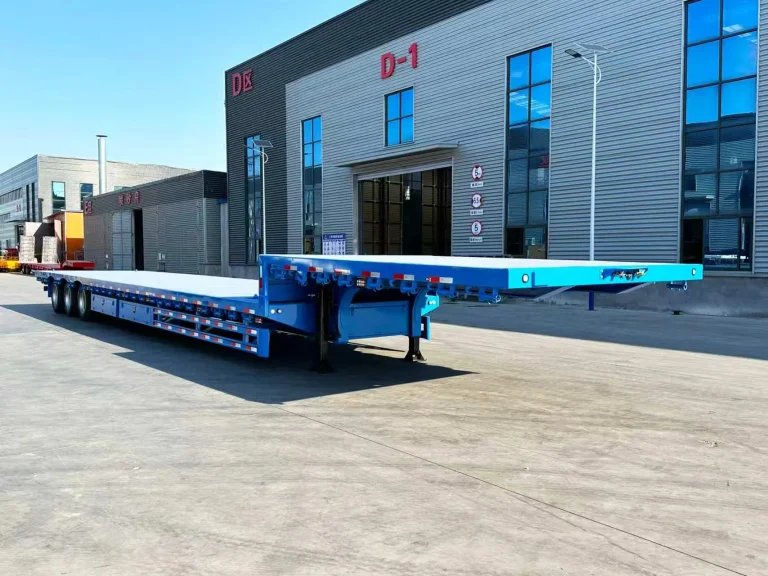
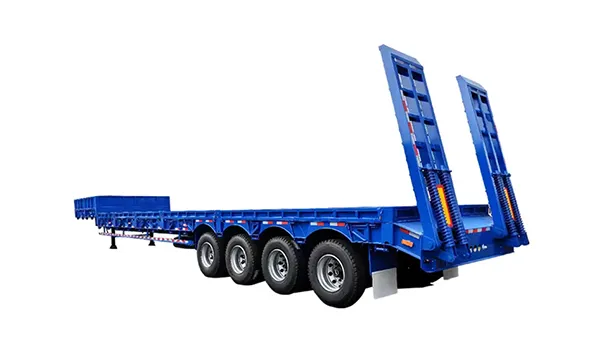
A semirremolque de plataforma baja Es un remolque de transporte pesado de plataforma baja que se utiliza para excavadoras, topadoras, cargadoras, maquinaria minera y otros equipos de gran tamaño. En comparación con un remolque de plataforma plana, su plataforma más baja reduce la altura de carga y el centro de gravedad. Las configuraciones comunes de CHENLU incluyen diseños de 3 y 4 ejes, suspensión mecánica y escaleras de carga mecánicas o hidráulicas.
Esquema del artículo
- ¿Qué es un semirremolque de plataforma baja?
- ¿Por qué es importante que la plataforma sea baja en el equipo pesado?
- ¿En qué se diferencian los remolques de plataforma baja de 3 y 4 ejes?
- ¿Qué significan realmente las capacidades nominales de 60, 80 y 100 toneladas?
- ¿En qué se diferencian las escaleras de carga hidráulicas y las mecánicas?
- Camión de plataforma baja, camión «lowboy» y camión de plataforma plana: ¿cuál es la diferencia?
- Preguntas frecuentes
¿Qué es un semirremolque de plataforma baja?
A semirremolque de plataforma baja es un semirremolque especializado con una plataforma de carga situada a un nivel más bajo que la de un remolque de plataforma estándar. Esta plataforma baja permite a una flota transportar equipo alto o pesado, al tiempo que se mantiene una mejor control sobre la altura total del vehículo cargado.
Entre la carga típica se incluyen:
- Excavadora
- Excavadora
- Cargadora de ruedas
- Rodillo compactador
- Pavimentador
- Maquinaria minera
- Maquinaria agrícola
- Equipos industriales
- Maquinaria pesada de construcción
El remolque se acopla a un camión semirremolque mediante el pivote de acoplamiento y la quinta rueda. La mayor parte de la maquinaria se coloca sobre la plataforma rebajada del remolque, mientras que el conjunto de ejes soporta la parte trasera de la carga.
CHENLU muestra actualmente ambos Camiones de plataforma baja de 3 y 4 ejes configuraciones. Sus tablas públicas de productos sitúan la gama de 3 ejes en un rango de 30 a 60 toneladas y la de 4 ejes en un rango de 60 a 100 toneladas, dependiendo del diseño final.
Esas cifras deben considerarse como orientaciones para la familia de productos, no como una capacidad de carga legal universal. Los límites locales por eje, el peso del tractor, las especificaciones de los llantes, la suspensión, las normas viales y el modelo exacto de la máquina influyen en la carga máxima permitida.
En la práctica, un camión de plataforma baja funciona porque cumple muy bien una función:
Mantiene la maquinaria pesada más baja y la sostiene sobre un chasis diseñado para soportar cargas pesadas concentradas.

¿Por qué es importante la plataforma baja para el transporte de maquinaria pesada?
La altura es uno de los mayores problemas en el transporte de maquinaria.
Una excavadora puede caber fácilmente en una plataforma estándar, pero una vez que se carga la máquina, su pluma, cabina o estructura superior pueden hacer que la altura total sea excesiva. En ese caso, los puentes, los túneles, las líneas eléctricas y las restricciones en las rutas pueden convertirse en obstáculos graves.
El diseño de plataforma baja reduce la altura de la plataforma cargada y, por lo tanto, baja la máquina.
Esto ofrece varias ventajas:
- Menor altura total de transporte
- Centro de gravedad más bajo
- Mayor estabilidad
- Planificación más sencilla de rutas
- Mayor idoneidad para maquinaria de gran altura
- Mayor control en las curvas y al frenar
El contenido reciente de CHENLU sobre dimensiones también destaca que la longitud y el ancho de la plataforma son solo una parte del asunto. Los compradores también deben verificar la altura de la plataforma cargada, el ángulo de la rampa, la distancia entre ejes, la geometría del cuello de cisne y la distancia al suelo de la máquina.
Por esta razón, no basta con pedir simplemente un “remolque bajo de 40 pies”.
Un proyecto profesional debe comenzar con la máquina en sí:
| Datos de la máquina |
Por qué es importante |
| Peso |
Determina los requisitos del chasis y los ejes |
| Longitud |
Determina la longitud de la cubierta |
| Ancho |
Determina el ancho de la terraza y los requisitos de permiso |
| Altura |
Determina la altura total con carga |
| Distancia al suelo |
Influye en el ángulo de la rampa de carga |
| Posición de la vía/rueda |
Afecta la carga concentrada en la cubierta |
| Centro de gravedad |
Influye en la estabilidad y la distribución del peso |
Por eso, dos máquinas con el mismo peso total pueden requerir diseños de plataforma baja diferentes.
¿En qué se diferencian los remolques de plataforma baja de 3 y 4 ejes?
Un remolque de plataforma baja de tres ejes es una de las configuraciones más comunes para el transporte de equipo pesado, ya que logra un equilibrio entre la distribución de la carga, la maniobrabilidad, el número de llantas y el mantenimiento.
La situación actual de CHENLU Camión de plataforma baja de 3 ejes indica un rango de carga para la familia de productos de 30 a 60 toneladas. El producto utiliza una estructura de acero de alta resistencia, una suspensión mecánica como configuración principal y escaleras de carga mecánicas o hidráulicas, según la configuración seleccionada.
A Camión de plataforma baja de 4 ejes pasa a una clase de transporte de mayor capacidad. La tabla compartida de CHENLU indica que el rango para los modelos de 4 ejes es de 60 a 100 toneladas, aunque en el texto de algunas páginas de productos específicos todavía se menciona “hasta 60 toneladas”. Esta discrepancia implica que la capacidad nominal definitiva debe confirmarse en las especificaciones técnicas aprobadas.
Una comparación sencilla se ve así:
| Configuración |
Dirección de la serie pública CHENLU |
Factor típico de decisión |
| 3 ejes |
30–60 toneladas |
Maquinaria de construcción estándar |
| 4 ejes |
60–100 toneladas |
Maquinaria más pesada y una mejor distribución de la carga |
| De varios ejes |
Específico del proyecto |
Requisitos especiales para el transporte de cargas pesadas |
Un mayor número de ejes permite distribuir el peso entre más posiciones de las ruedas, pero también añade:
- Peso en vacío del remolque
- Llantas
- Rodamientos
- Componentes de frenos
- Piezas de suspensión
- Costo de mantenimiento
Por lo tanto, un remolque bajo de 4 ejes no es automáticamente mejor que un modelo de 3 ejes.
El número adecuado de ejes depende de la maquinaria, el tractor, la ruta y los límites legales de las carreteras.

¿Qué significan realmente las clasificaciones de plataforma baja de 60, 80 y 100 toneladas?
Búsquedas como “remolque de plataforma baja de 60 toneladas”, “remolque de plataforma baja de 80 toneladas”, “remolque de plataforma baja de 100 toneladas” y “remolque de plataforma baja de 4 ejes y 100 toneladas” son comunes porque los compradores suelen partir del peso de la máquina.
Pero el número que aparece en el título de un producto no lo dice todo.
CHENLU tiene actualmente un Remolque semirremolque de cama baja de 60 toneladas página que posiciona claramente el producto para cargas de hasta 60 toneladas. También presenta una tabla de la familia de productos que muestra las versiones de 3 ejes (30–60 toneladas) y de 4 ejes (60–100 toneladas).
La empresa también ha incluido un modelo de plataforma baja de 80 toneladas en su catálogo público y en su información dimensional más reciente.
Sin embargo, los compradores deben distinguir entre:
Capacidad nominal del remolque y carga útil legal en carretera
No siempre son iguales.
La carga útil práctica puede verse limitada por:
- Peso en vacío del remolque
- Peso en vacío del tractor
- Límites del grupo de ejes
- Clasificaciones de llantas
- Reglas del bridge
- Límites brutos de combinación locales
- Condiciones del permiso
Por lo tanto, el hecho de que un camión de plataforma baja tenga una capacidad de 100 toneladas no significa automáticamente que una flota pueda transportar legalmente una máquina de 100 toneladas por cualquier carretera.
La misma precaución se aplica a las búsquedas de remolques de plataforma baja de 120 toneladas u 8 ejes. Estos pertenecen a una categoría más especializada de transporte pesado y deben considerarse proyectos de ingeniería, en lugar de simples extensiones de la gama estándar actual de remolques de plataforma baja de CHENLU.
Para el transporte de cargas extremadamente pesadas, un remolque modular u otra solución de múltiples ejes puede resultar más adecuado que un remolque de plataforma baja estándar.
¿En qué se diferencian las escaleras de carga hidráulicas y las mecánicas?
Un camión de plataforma baja no solo debe transportar el equipo, sino que también debe permitir que el equipo se suba a la plataforma.
CHENLU ofrece actualmente un remolque de plataforma baja con escalera hidráulica. El El sistema hidráulico ayuda a subir y bajar las secciones de carga traseras para que los operadores puedan ajustar el ángulo de carga según las diferentes máquinas.
Escalera hidráulica
Entre las ventajas se incluyen:
- Manejo más sencillo
- Menos trabajo manual
- Ángulo de carga ajustable
- Mayor comodidad para el traslado repetido de equipos
- Carga más rápida para flotas de alquiler y contratistas
Escalera mecánica
Entre las ventajas se incluyen:
- Estructura más sencilla
- Menor complejidad del sistema
- Mantenimiento más sencillo en mercados remotos
- Orientación hacia un menor costo inicial
Una cargadora con poca distancia al suelo puede necesitar un ángulo de rampa más suave que una máquina con mayor distancia al suelo.
Por eso es importante la geometría de la rampa.
Una rampa mal elegida puede provocar:
- Contacto con la parte inferior de la máquina
- Deslizamiento de la vía
- Retrasos en la carga
- Ángulos de aproximación inseguros
Para las flotas que transportan maquinaria a diario, una escalera hidráulica puede aportar un verdadero valor operativo. Para operaciones en zonas remotas con capacidad limitada de servicio hidráulico, un sistema mecánico más sencillo puede resultar atractivo.
La respuesta correcta depende de la frecuencia con la que el remolque cargue equipo y del lugar donde opere.

Camión de plataforma baja, camión «lowboy» y camión de plataforma plana: ¿cuál es la diferencia?
Los términos «lowbed», «lowboy» y «low loader» suelen utilizarse indistintamente en los mercados mundiales de remolques.
En muchas búsquedas internacionales B2B, los términos “remolque de plataforma baja” y «remolque lowboy» se refieren a productos similares para el transporte de equipo pesado con plataforma baja. La nomenclatura varía según la región, pero el objetivo principal es el mismo: transportar maquinaria alta y pesada con una altura de plataforma reducida.
Un semirremolque de plataforma tiene una plataforma de carga más alta que se extiende a lo largo de toda la longitud del vehículo y se utiliza principalmente para el transporte de carga general, contenedores, acero, madera y otros tipos de carga.
| Tipo de remolque |
Fortaleza principal |
Carga típica |
| Camión de plataforma |
Flexibilidad en el transporte de carga |
Contenedores, acero, madera |
| Camión de plataforma baja |
Servicio de apoyo para camiones de plataforma baja y maquinaria pesada |
Excavadoras, cargadoras |
| Lowboy |
Función similar de transporte de carga pesada con plataforma baja |
Maquinaria de construcción |
| RGN |
Carga frontal a través de un cuello desmontable |
Maquinaria grande autopropulsada |
Un remolque de plataforma estándar puede transportar equipo más pequeño, pero la maquinaria alta puede generar una altura de carga excesiva.
Un semirremolque de plataforma baja coloca ese equipo más cerca de la carretera.
Por eso, a medida que aumenta el tamaño de la maquinaria, los contratistas de la construcción suelen pasar de las plataformas planas a los semirremolques de plataforma baja.
El término “remolque de plataforma baja” también es común en Europa, África, el Medio Oriente y otros mercados. Las búsquedas de “remolque de plataforma baja de tres ejes” o «semirremolque de plataforma baja» suelen referirse a la misma categoría general de transporte de equipo pesado.
¿De qué manera la personalización de las plataformas bajas OEM da apoyo a los distintos mercados?
Un fabricante chino de remolques de plataforma baja que abastece a los mercados mundiales debe adaptar su producto a diferentes tipos de carreteras, maquinaria y normativas.
CHENLU comercializa sus remolques para maquinaria y equipo destinados a excavadoras, topadoras, cargadoras y máquinas mineras que operan en regiones como África, Sudamérica y Asia Central.
Para un Proyecto OEM, normalmente necesitamos información como:
- Tipo de máquina
- Peso de la máquina
- Dimensiones totales de la máquina
- Distancia entre orugas o ruedas
- Distancia al suelo
- Modelo de tractor
- Altura de la quinta rueda
- Condiciones de la carretera
- Límites locales de los ejes
- Método de carga requerido
A partir de ahí, el tráiler se puede configurar en función de:
- Estructura de 3 o 4 ejes
- Ancho de la cubierta
- Longitud de la cubierta
- Sistema de rampas
- Estructura de acero
- Suspensión
- Llantas
- Estrategia de marca
- Requisitos de exportación
Las búsquedas de «remolque de plataforma baja Faymonville», por ejemplo, pueden provenir de compradores que comparan marcas europeas reconocidas de transporte de carga pesada con otros fabricantes. Las comparaciones entre marcas pueden ser útiles, pero la decisión final debe basarse en las especificaciones técnicas reales, en lugar de copiar el diseño de otra marca.
El mismo principio se aplica a las búsquedas de un remolque de plataforma baja extensible, un remolque con carro auxiliar o un remolque de plataforma baja de 8 ejes. Se trata de diferentes configuraciones para el transporte de carga pesada y deben diseñarse por separado, en lugar de considerarse opciones estándar en todos los remolques de plataforma baja.
Preguntas frecuentes
¿Para qué se utiliza un semirremolque de plataforma baja?
Un semirremolque de plataforma baja se utiliza para transportar excavadoras, topadoras, cargadoras, maquinaria de minería, equipo de construcción y otras máquinas grandes o altas. Su plataforma baja ayuda a reducir la altura total de la carga y el centro de gravedad.
¿Cuál es la diferencia entre un camión de plataforma baja de 3 ejes y uno de 4 ejes?
La tabla de la serie pública actual de CHENLU incluye modelos de 3 ejes con capacidades de entre 30 y 60 toneladas y configuraciones de 4 ejes con capacidades de entre 60 y 100 toneladas. La carga útil legal definitiva depende del diseño del remolque, el tractor, los límites de los ejes, los llantes y las regulaciones locales.
¿Un «lowbed» es lo mismo que un remolque «lowboy»?
Estos términos suelen referirse a la misma familia general de remolques de plataforma baja para equipo pesado, aunque la denominación varía según la región y el diseño específico.
¿Puede un camión de plataforma baja transportar una máquina de 80 toneladas?
CHENLU presenta una configuración de plataforma baja de 80 toneladas, pero la capacidad legal y estructural definitiva debe confirmarse en función de la configuración exacta, la disposición de los ejes, las dimensiones de la máquina, el tractor y las normas viales locales.



 25 de agosto de 2026