Choosing the wrong trailer can reduce payload efficiency,type of trailer, increase tire wear, and make transport harder to manage. For fleet owners, one wrong decision can affect daily profit. Understanding the semi-trailer vs full trailer difference helps you choose safer, stronger, and more efficient equipment.
A semirremolque does not have a front axle and must connect to a tractor unit through a fifth wheel. A full trailer has both front and rear axles and is pulled by a tow vehicle using a drawbar or coupling device. The main differences are structure, weight distribution, maneuverability, load capacity, and transport use.

The style of the semi-trailer
Esquema del artículo
What is a semi-trailer?
What is a full trailer?
What is the difference between semi-trailers and full trailers?
How does axle design affect trailer performance?
How does weight distribution differ?
Which trailer has better maneuverability?
Which trailer is better for long-distance transportation?
What cargo types suit semi-trailers and full trailers?
How do coupling, drawbar, and fifth wheel systems differ?
How should fleet buyers choose the right trailer?
Preguntas frecuentes
Puntos clave
What Is a Semi-Trailer?
A semi-trailer is a trailer without a front axle. The front part of the semirremolque is supported by a tractor unit, and the rear part is supported by its own axle group. This means the weight of the semi-trailer is partly carried by the tractor.
In simple terms, type of trailer,a semi-trailer is a trailer that cannot stand fully loaded without a tractor. It connects to the tractor through a fifth wheel, which helps transfer part of the trailer load to the drive axles of the tractor. This is a type of trailer and this design gives the vehicle better traction and strong transport performance.
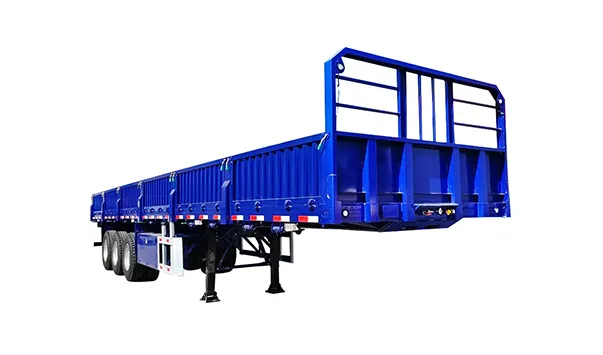
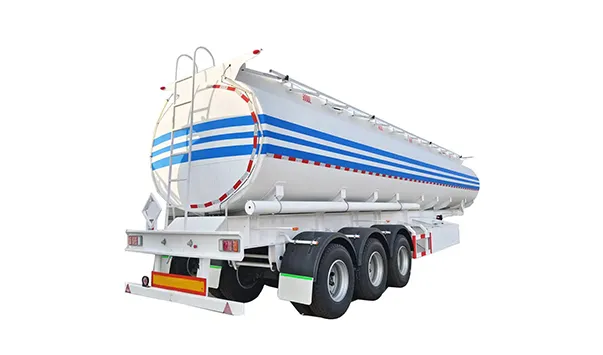
Common semi-trailers include:
| Semi-Trailer Type |
Uso principal |
| Semirremolque de plataforma |
Containers, steel, machinery, bulk cargo |
| Remolque portacontenedores tipo esqueleto |
Container logistics and port transport |
| Lowbed / lowboy trailer |
Heavy equipment and construction machinery |
| Remolque cisterna para combustible |
Liquid fuel and energy transport |
| Bulk cement tanker trailer |
Cement, powder, dry bulk logistics |
| Semirremolque volquete |
Mining, construction, sand, gravel |
| Side curtain trailer |
Palletized cargo and fast side loading |
For heavy-duty transport, semi-trailers are widely used because they support large cargo volume, strong load-bearing capacity, and efficient long-distance transportation.
What Is a Full Trailer?
A full trailer is a trailer with both front and rear axles. The trailer is borne by its own axles, not by the tractor. It is connected to the towing vehicle through a drawbar or coupling device.
A full trailer is relatively independent because its own axle structure supports the weight of the trailer and cargo. The tow vehicle mainly provides pulling force. This design is different from a semi-trailer, where the tractor also bears the trailer load.
The design of full trailers. Full trailers are used in agriculture, short-distance transportation, industrial yards, and some regional cargo operations.They can need use loads than full thrailers. In some markets, full trailers are designed,a full trailer may also be connected behind a straight truck or road tractor for special transport needs.

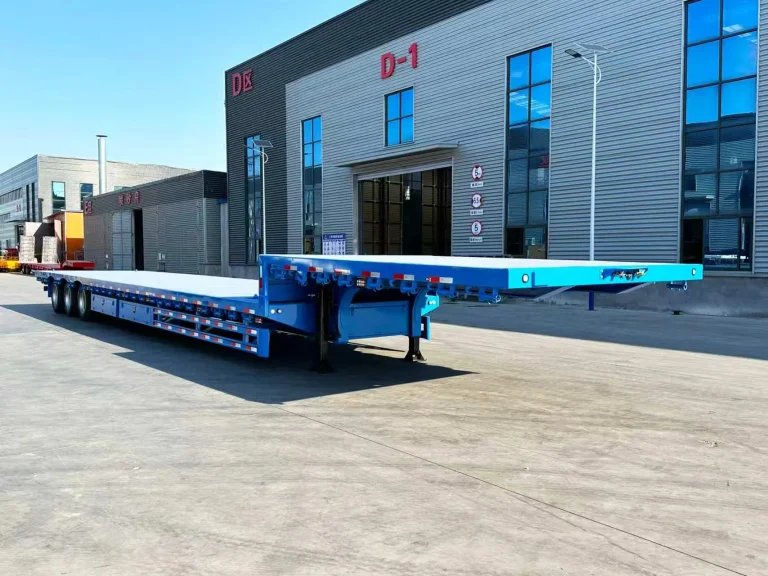
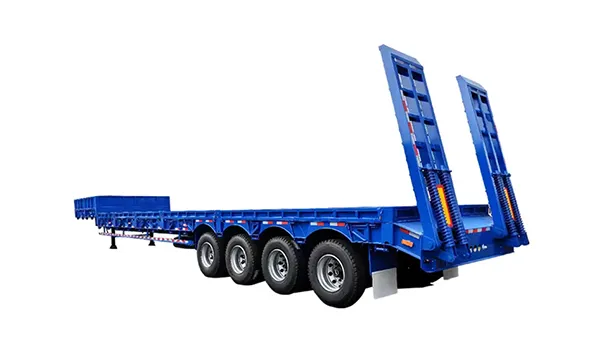
Se han enviado con éxito semirremolques de plataforma baja de tres ejes a Nigeria
What Is the Difference Between Semi-Trailers and Full Trailers?
The difference between semi-trailers and full trailers starts with structure. A semi-trailer doesn’t have a front axle, while a full trailer has front and rear axles.The design of full trailers. This single design difference affects almost everything: coupling, weight distribution, maneuverability, braking, stability, and application.
Here are the key differences:
| Artículo |
Semi-Trailer |
Full Trailer |
| Front axle |
No front axle |
Has front axle |
| Connection |
Quinta rueda |
Drawbar or coupling |
| Weight support |
Tractor + rear axle group |
Trailer’s own axles |
| Maneuverability |
Better for highway and large loads |
More difficult to reverse |
| Common use |
Long-distance cargo, heavy loads |
Short-distance or special transport |
| Load transfer |
Partly transferred to tractor |
Mostly carried by trailer axles |
| Stability at high speeds |
Usually better when matched correctly |
Depends strongly on drawbar design |
| Fleet use |
Very common in logistics and heavy transport |
More limited by region and application |
For global fleet owners, choosing the right trailer depends on transportation needs, road conditions, cargo types, local regulations, and the available tractor unit.
How Does Axle Design Affect Trailer Performance?
The axle design decides how the load of the trailer is supported. A semi-trailer has rear axles, while the tractor supports the front section. A full trailer has front and rear axles, so it carries its own weight more independently.
Because a semi-trailer shares load with the tractor, it can create better load balance between trailer axles and axles of the tractor unit. This can improve traction, especially when the tractor needs grip for heavy loads.
A full trailer uses its own front axle and rear axle group. This design can work well for certain cargo tasks, but it may have more complex turning behavior because the drawbar, front axle, and rear axle must follow the tow vehicle.
How Does Weight Distribution Differ?
Weight distribution is one of the most important differences between full trailers and semi-trailers. In a semi-trailer, part of the weight is transferred to the tractor through the fifth wheel. The rest is supported by the trailer axle group.
In a full trailer, the weight of the trailer and cargo is mostly carried by the trailer’s own axles. The tow vehicle provides pulling force but does not bear as much vertical load as a tractor pulling a semi-trailer.
This matters because weight distribution affects tire wear, brake performance, payload planning, and road compliance. For heavy cargo, low center of gravity and correct axle load are essential for safe and efficient transportation.
Which Trailer Has Better Maneuverability?
Maneuverability is usually better with a semi-trailer in long-distance and highway transport. A skilled driver can control a semi-trailer more easily when turning, reversing, and positioning at loading points.
A full trailer can be harder to reverse because it has a drawbar and steering behavior that differs from a semi-trailer. The front axle and drawbar can create more movement points. This makes reversing more difficult for many drivers. They can need use loads than full thrailers.
However, a full trailer can still be useful in specific transportation operations where the route, speed, and loading area are suitable. The right choice depends on road width, yard space, driver skill, and transport route.

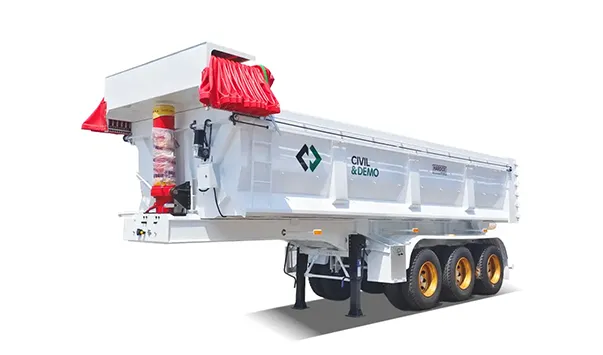
Semirremolque basculante hidráulico para un proyecto de construcción en Arabia Saudita
Which Trailer Is Better for Long-Distance Transportation?
For long-distance transportation, semi-trailers are usually the preferred choice. They work well with road tractors, carry heavy loads, and offer strong efficiency for highways, ports, intermodal transport, and international cargo movement.
A semi-trailer can also be customized for many industries. Flatbed semi trailers, lowbed trailers, fuel tanker trailers, aluminum tanker trailers, bulk cement tanker trailers, dump semi trailers, and car carrier trailers all support different freight tasks.
A full trailer is mainly used in shorter routes, local delivery, agricultural work, and special transport situations depending on local rules. Compared with full trailer designs, a semi-trailer often offers better load flexibility and wider global market use.
What Cargo Types Suit Semi-Trailers and Full Trailers?
Different cargo types need different trailer structures. Semi-trailers are suitable for container logistics, machinery transport, fuel transport, powder transport, bulk cargo transport, and construction material movement. They can handle heavy loads and long transport routes.
A full trailer may suit cargo that needs local movement, yard transport, or special towing arrangements. It can be useful where a tow vehicle must pull a trailer that supports its own weight.
| Cargo / Project Type |
Better Trailer Option |
| Container logistics |
Skeleton semi-trailer |
| Maquinaria de construcción |
Lowbed or lowboy semi-trailer |
| Fuel and liquid transport |
Tanker semi-trailer |
| Cement and powder logistics |
Bulk cement semi-trailer |
| Mining material |
Dump semi-trailer |
| Local yard transport |
Full trailer may be suitable |
| Agricultural cargo |
Full trailer may be suitable |
| Long highway freight |
Semi-trailer |
For international project buyers, the trailer should match the cargo, loading method, road condition, and legal axle load.
How Do Coupling, Drawbar, and Fifth Wheel Systems Differ?
The coupling system is another major difference. A semi-trailer connects to the tractor unit through a fifth wheel. This connection allows the tractor to bear the front load and provide strong traction.
A full trailer is connected to the towing vehicle with a drawbar and coupling device. The drawbar pulls the full trailer, while the trailer’s own axles carry most of the weight.
These systems affect safety, turning, braking, and driver control. For heavy-duty fleet operations, buyers should confirm the coupling standard, kingpin size, brake system, electrical connection, and local transport regulation before ordering.
How Do Braking and Stability Differ?
A trailer brake system must match the trailer weight, axle design, and transport speed. Semi-trailers commonly use air brake systems connected to the tractor. This supports stable braking for heavy-duty cargo.
A full trailer also needs a reliable braking system, especially when carrying heavy loads. Because the full trailer carries its own weight on front and rear axles, brake balance must be carefully matched.
At high speeds, stability depends on the trailer design, center of gravity, tire condition, suspension, road quality, and load position. Poor loading can make either trailer unsafe. Good engineering and proper operation are both important.
How Should Fleet Buyers Choose the Right Trailer?
Choosing the right trailer begins with your real transport job. Do not only compare price. Compare load, route, cargo, road conditions, maintenance ability, and local legal requirements.
Fleet buyers should ask:
¿Qué tipo de carga llevará el remolque?
What is the required payload?
Will the route be highway, port, mine, city road, or rough road?
What tractor or tow vehicle will be used?
Are local axle load regulations strict?
Does the trailer need OEM / ODM customization?
What delivery time and after-sales support are required?
Will the trailer need spare parts support for long-term operation?
As a professional semi trailer manufacturer in China, we specialize in the design, production, customization, and export of heavy-duty transportation trailers. Our products include flatbed semi trailers, skeleton container trailers, side curtain trailers, sidewall and fence trailers, lowbed trailers, lowboy trailers, removable gooseneck trailers, tanker trailers, dump semi trailers, car carrier trailers, trucks, and trailer parts.
Why Do B2B Buyers Prefer Semi-Trailers for Heavy-Duty Fleet Operations?
Many B2B buyers prefer semi-trailers because they provide strong carrying capacity, better load planning, and efficient transportation for heavy cargo. They also work well with standard tractor units used in international logistics.
For fleet owners, logistics companies, port operators, construction contractors, mining companies, tanker operators, and truck dealers, semi-trailers are easier to match with common transport tasks. They can also be customized for different industries.
OEM / ODM options may include:
Trailer length and width
Cantidad y marca de los ejes
Tipo de suspensión
Tire configuration
Loading platform structure
Steel grade and beam design
Tank material and volume
Sidewall or fence height
Sistemas de frenos y eléctricos
Color de la pintura y logotipo
Local regulation adaptation
The right semi-trailer design helps improve durability, load-bearing strength, welding reliability, and long-term fleet value.
Example: Choosing Between a Semi-Trailer and a Full Trailer
Imagine a logistics company needs to haul containers from a port to inland warehouses. The company needs highway stability, good payload, and fast loading at the terminal. In this case, a skeleton semi-trailer is usually the better option.
Now imagine a farm or local industrial yard needs to move goods over short distances with a lower-speed tow vehicle. A full trailer may be practical if local regulations allow it and the operation does not require long highway travel.
This example shows that full trailers and semi trailers both have value. The best choice depends on specific transportation requirements, not just the name of the trailer.
FAQs About Semi-Trailer vs Full Trailer
What is the main difference between a full trailer and a semi-trailer?
The main difference is axle support. A full trailer has front and rear axles and supports its own weight. A semi-trailer does not have a front axle and relies on a tractor unit to support its front part.
Is a semi-trailer better than a full trailer?
A semi-trailer is usually better for long-distance transportation, heavy loads, highway freight, and container logistics. A full trailer may be better for short-distance or special local transport depending on the application.
Why does a semi-trailer need a tractor?
A semi-trailer needs a tractor because it has no front axle. The tractor supports the front section through the fifth wheel and provides traction to tow the trailer.
What is a full trailer used for?
A full trailer is used for local cargo transport, agricultural transport, yard movement, and some special transport tasks. It has its own axles and is pulled by a tow vehicle through a drawbar.
Which trailer has better maneuverability?
Semi-trailers usually have better maneuverability for highway transport and reversing at loading sites. Full trailers can be more difficult to reverse because of the drawbar and front axle design.
Can a full trailer carry heavy loads?
Yes, a full trailer can carry heavy loads if it is designed correctly. However, semi-trailers often handle larger commercial freight tasks more efficiently because of better load transfer to the tractor and wider heavy-duty transport use.
Conclusiones clave
A semi-trailer does not have a front axle and connects to a tractor through a fifth wheel.
A full trailer has front and rear axles and connects to a tow vehicle through a drawbar.
Semi-trailers are widely used for long-distance transportation and heavy-duty cargo.
Full trailers are more common in short-distance, local, or special transport tasks.
Weight distribution differs because a semi-trailer transfers part of its load to the tractor.
Maneuverability is usually better with a semi-trailer in highway and logistics operations.
Cargo type, road condition, axle load rules, and tractor compatibility should guide trailer selection.
For global B2B buyers, OEM / ODM customization helps match trailers to real project conditions.
A factory-direct semi trailer manufacturer can support design, production, export, and long-term fleet cooperation.



 1 de junio de 2026