Choosing the wrong truck and trailer can raise costs, delay loading, damage cargo, and create road compliance problems. The terms also sound alike, which makes buying harder. The solution is to understand what the tractor does, what the trailer carries, and how the full combination works.
A semi-truck usually means the powered tractor, while a semirremolque is the unpowered cargo unit connected behind it. A tractor-trailer is the complete combination. Unlike a full trailer, a semi-trailer transfers part of its loaded weight to the tractor through the fifth-wheel connection. The right trailer depends on cargo, payload, road conditions, loading method, and local regulations.

Esquema del artículo
- What is a semi-truck?
- What is a semi-trailer?
- What is the difference between a semi-truck and a semi-trailer?
- How does a tractor and trailer combination work?
- What are the main types of semi trailers?
- Which trailer type fits each type of cargo?
- How do flatbed, dry van, reefer, tanker, and lowboy trailers differ?
- How do axles and weight limits affect trailer selection?
- What is the difference between day cab and sleeper tractors?
- How should buyers choose a semi trailer manufacturer?
- Preguntas frecuentes
What Is a Semi-Truck?
A semi truck is the powered part of a commercial tractor-trailer combination. It contains the engine, transmission, cab, steering system, front axle, drive axles, fuel system, and fifth wheel. It supplies the power needed for pulling a trailer, but it normally does not carry the main cargo by itself.
The Federal Motor Carrier Safety Administration describes a truck tractor as a power unit designed to pull a semi-trailer. The tractor itself has little or no cargo-carrying function without an attached trailer.
People use several names for this vehicle:
- Semi truck
- Semi-truck
- Truck tractor
- Tractor unit
- Tractor de carretera
- Prime mover
- Big rig
- Tractor-trailer, when the trailer is attached
The front of the truck contains the cab and engine. The rear of the truck includes the drive axles and fifth wheel. The fifth wheel locks onto the trailer’s kingpin and supports part of the trailer load.
A semi-truck should not be confused with a straight truck. A straight truck has its cargo body fixed to the same chassis as the cab. A tractor can disconnect from one trailer and connect to another. This flexibility is one reason tractor-trailers are widely used in port, fleet, warehouse, and long-haul operations. FMCSA notes that tractors often pull different trailers during their working life rather than staying paired with one unit.

What Is a Semi-Trailer?
A semirremolque is an unpowered cargo vehicle that does not have a front axle supporting its full weight. Its front section rests on the fifth wheel of the tractor. This means part of the trailer weight and cargo weight is transferred to the tractor.
That weight-sharing design explains the word “semi.” The trailer is only partly supported by its own axle group. It needs a tractor, converter dolly, or another suitable towing unit to operate normally.
A semi-trailer may be designed to transport:
- Contenedores
- Palletized cargo
- Building materials
- Steel coils and pipes
- Maquinaria de construcción
- Equipo minero
- Fuel and liquid products
- Cement and dry powder
- Sand, coal, ore, or gravel
- Passenger vehicles
- Oversized industrial parts
The structure changes according to the type of cargo. A flatbed trailer has an open deck. A tanker trailer uses a tank body. A lowboy has a lower loading platform. A dump trailer includes a hydraulic lifting system.
A full trailer is different. It has front and rear axles supporting its complete weight. A full trailer connects to the towing vehicle through a drawbar. A semi-trailer transfers part of its weight to the tractor through the fifth wheel.

What Is the Difference Between a Semi-Truck and a Semi-Trailer?
The main difference between a semi-truck and a semi-trailer is simple: **the truck provides power, while the trailer carries cargo**.
| Componente |
Semi-Truck or Tractor |
Semi-Trailer |
| Motor |
Yes |
No |
| Driver’s cab |
Yes |
No |
| Steering system |
Yes |
No |
| Objetivo principal |
Pull the load |
Carry the load |
| Front support |
Front axle |
Tractor fifth wheel or landing gear |
| Can operate alone |
Yes, as a bobtail |
No |
| Can be exchanged |
Can pull different trailers |
Can be pulled by compatible tractors |
| Main selection factors |
Engine, transmission, axle drive, cab |
Cargo, payload, dimensions, axles, body structure |
The term semi-trailer truck usually describes the complete articulated truck. This includes the tractor and the attached semi-trailer. “Semi truck and trailer” and “tractor and trailer” are also common phrases.
A truck driver may casually call the full combination a “semi.” A fleet buyer, however, should separate the two parts during purchasing. Buying a semi trailer does not normally include the tractor. Likewise, a listing for used semi trucks for sale may refer only to the powered unit.
This distinction matters when comparing price, warranty, spare parts, technical specifications, and shipping arrangements.
How Does a Tractor and Trailer Combination Work?
The tractor connects to the front of the trailer through a fifth wheel and kingpin. The trailer also connects to the truck through air lines and electrical cables.
These systems allow the tractor to provide:
- Pulling power
- Braking air
- Electrical power
- Turn signals
- Brake lights
- Stability support at the coupling point
When the truck turns, the tractor and trailer move around the fifth-wheel connection. This creates an articulated truck. The trailer follows a different turning path from the tractor, so truck drivers must allow extra space around corners.
A typical trailer combination may use two tractor axles and three trailer axles, creating a five-axle tractor-trailer. The Federal Highway Administration classifies single-trailer trucks according to both unit count and axle count. Its classification includes vehicles with four or fewer axles, five axles, and six or more axles.
When the trailer is disconnected, its landing gear supports the front section. The tractor moves forward and can connect to another trailer. This helps a fleet keep cargo moving even while one trailer is being loaded, unloaded, inspected, or repaired.
What Are the Main Types of Semi Trailers?
There is no single type of semi-trailer that fits every job. Each design solves a different transport problem.
Semirremolque de plataforma
A flatbed has an open, level loading platform. It can haul containers, steel, timber, machinery, pallets, construction materials, and oversized cargo.
A flatbed trailer offers flexible loading from the side, rear, or top. Cargo must be secured with chains, straps, twist locks, or other suitable systems.
Skeleton Container Trailer
A skeleton trailer is a container chassis. It uses a lighter frame with twist locks positioned for standard containers. It is common in ports, container yards, railway terminals, and intermodal transport.
Unlike a flatbed, it has no complete deck for loose cargo. Its main purpose is container transport.
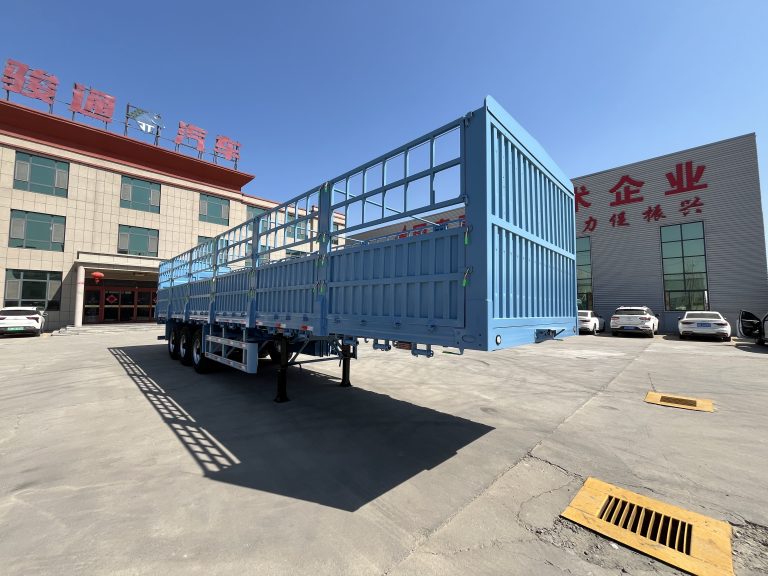
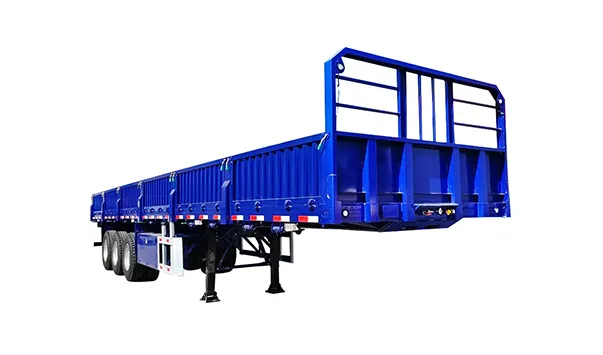
Sidewall and Fence Trailer
A sidewall trailer has solid opening panels around the loading platform. A fence trailer adds a higher, ventilated body.
These semi-trailers can transport grain, vegetables, livestock, bagged goods, construction materials, and other bulk cargo that needs more side protection.
Side Curtain Trailer
A side curtain or curtain-side trailer has flexible curtains along the side of the trailer. It allows quick side access for forklifts while protecting cargo from normal weather exposure.
It is often selected for palletized cargo, regional distribution, and warehouse-to-warehouse transport.
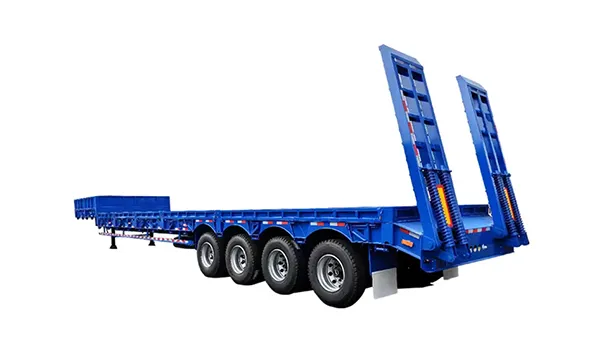
Lowbed, Lowboy, and Gooseneck Trailer
A lowbed or lowboy lowers the main deck closer to the road. This creates more vertical space for tall machinery and reduces the center of gravity.
A gooseneck trailer may use rear ramps, a folding gooseneck, or a removable gooseneck. A **removable gooseneck** allows equipment to drive onto the trailer from the front. This design is useful for excavators, bulldozers, loaders, and other heavy machines.
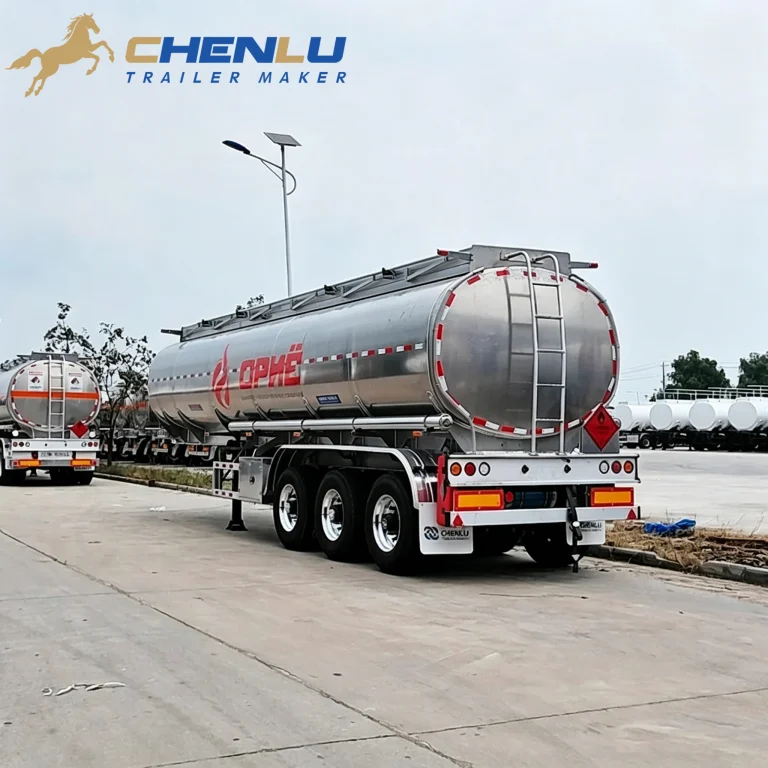
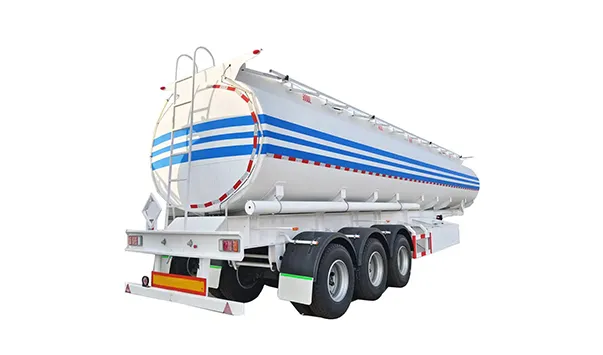
Tanker Trailer
A tanker trailer carries liquid or dry bulk material. Common versions include:
- Remolque cisterna para combustible
- Remolque cisterna de aluminio
- Camión cisterna de acero inoxidable
- Camión cisterna de asfalto
- Buque cisterna para productos químicos
- Bulk cement tanker
Tank material, tank shape, compartments, valves, pumping equipment, and discharge systems must match the cargo.
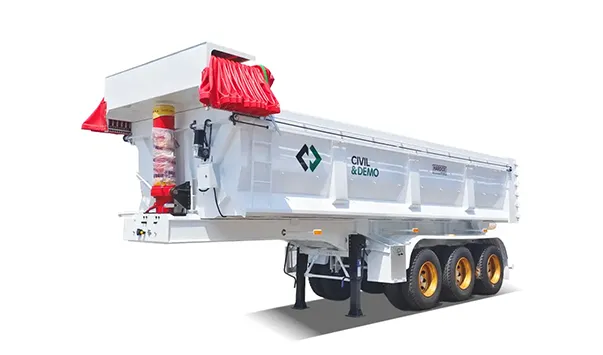
Semirremolque volquete
Dump trailers use a hydraulic system to raise the cargo body. Rear dump and side dump designs are common. They can transport sand, gravel, coal, ore, agricultural material, and construction waste.
Car Carrier Trailer
A car carrier uses one or more loading decks to move passenger vehicles. Hydraulic lifting systems can help adjust the deck position during loading.
Which Trailer Type Fits Each Type of Cargo?
Selecting a semi-trailer should begin with the cargo, not with price.
Ask these questions first:
1. What is the type of cargo?
2. How much does it weigh?
3. What are its size and shape?
4. How will workers load and unload it?
5. Does it need weather protection?
6. Is the cargo liquid, powder, machinery, containers, or loose material?
7. What tractor will tow the trailer?
8. What road and axle rules apply?
The following chart offers a simple starting point:
| Cargo or Operation |
Recommended Trailer Type |
Main Reason |
| ISO containers |
Skeleton or flatbed |
Twist-lock container securing |
| Containers plus general cargo |
Camión de plataforma |
Greater cargo flexibility |
| Palletized goods |
Side curtain or dry van |
Fast access or enclosed protection |
| Steel, pipes, timber |
Camión de plataforma |
Open loading platform |
| Grain and agricultural goods |
Sidewall or fence |
Side containment |
| Excavators and loaders |
Lowbed or lowboy |
Low loading height |
| Very heavy machinery |
Multi-axle or detachable trailer |
Mejor distribución de la carga |
| Fuel and liquids |
Remolque cisterna |
Cargo-specific tank body |
| Cement and powder |
Bulk cement tanker |
Pneumatic discharge |
| Sand, coal, and gravel |
Remolque volquete |
Hydraulic unloading |
| Passenger vehicles |
Car carrier |
Multi-level vehicle transport |
A cheap trailer used for the wrong cargo can become expensive. It may reduce payload, slow loading, increase maintenance, or fail to comply with local rules.
How Do Flatbed, Dry Van, Reefer, Tanker, and Lowboy Trailers Differ?
A flatbed is open. A dry van is enclosed. A reefer is an enclosed refrigerated trailer. A tanker carries bulk liquid or powder. A lowboy carries tall or heavy machinery.
| Tipo de remolque |
Enclosed? |
Mejor aplicación |
Limitación principal |
| Camión de plataforma |
No |
Steel, containers, machinery |
Cargo needs securement and weather protection |
| Camioneta de carga seca |
Yes |
Boxes and general freight |
Limited side and top loading |
| Reefer trailer |
Yes |
Temperature-controlled cargo |
Higher system and maintenance complexity |
| Tanker |
Tank body |
Liquid or powder |
Cargo compatibility is critical |
| Lowboy |
Open, low deck |
Maquinaria pesada |
Specialized loading and route planning |
| Remolque volquete |
Open body |
Loose bulk material |
Not suitable for most packaged cargo |
How Do Axles and Weight Limits Affect Trailer Selection?
Axles support the trailer, transfer weight to the road, and affect stability. Adding axles can help distribute a heavy load, but more axles do not automatically make a better trailer.
The correct axle trailer arrangement depends on:
- Gross vehicle weight
- Carga útil
- Configuración del eje del tractor
- Front axle and rear axle limits
- Dimensiones del remolque
- Tipo de suspensión
- Clasificación de los neumáticos
- Kingpin position
- Local bridge and road rules
- Radio de giro
- Condiciones de la ruta
A trailer with three axles is common in many markets, but local laws may require a different layout. Weight limits vary between countries, states, provinces, road classes, and permit systems. FHWA also notes that commercial vehicle size and weight rules involve both federal and state requirements in the United States.
Buyers should never select an axle count based only on another fleet’s trailer. Two companies may carry similar cargo but operate under different road laws.
Before production, provide the manufacturer with:
- Carga útil objetivo
- Marca y modelo del tractor
- Altura de la quinta rueda
- Intended routes
- Maximum legal axle load
- Required tire size
- Desired suspension
- Frecuencia de carga
- Road surface conditions
This information helps the engineering team calculate the correct structure instead of simply adding steel and weight.
What Is the Difference Between a Day Cab and a Sleeper Semi-Truck?
The cab is part of the truck, not the trailer. Still, cab selection affects the full truck and trailer operation.
A day cab has no sleeping compartment. It is shorter and is often used for local delivery, port transport, construction work, and short regional routes.
A sleeper includes a rest area behind the driver. It is used for long-haul trucking, where drivers may spend several days away from their home base.
Common cab styles include:
- Day cab
- Flat roof sleeper
- Raised roof sleeper
- Flat roof cab
- Raised roof cab
A raised roof sleeper usually provides more interior space than a flat roof sleeper. However, a larger sleeper adds length and weight to the tractor.
When choosing a semi-truck, consider route length, driver comfort, fuel efficiency, turning space, tractor weight, and trailer application. A large sleeper may work well for long-distance highway transport but offer little value for short port movements.
How Should Buyers Choose a Semi Trailer Manufacturer in China?
A reliable semi trailer manufacturer should do more than offer a low price. The factory must understand cargo, road conditions, tractor compatibility, loading methods, and local regulations.
As a professional semi trailer manufacturer in China, we begin by asking how the trailer will work. We then develop an OEM or ODM configuration around the customer’s real operation.
A serious evaluation should cover five areas.
1. Engineering Ability
The supplier should ask for payload, dimensions, cargo type, road conditions, and tractor information. Be cautious if the factory offers the same design to every buyer.
2. Material and Welding Control
Check the steel or aluminum specification, main beam design, cross-member arrangement, welding process, axle installation, and surface treatment.
CHENLU’s manufacturing process includes material preparation, main beam welding, frame assembly, surface treatment, painting, final assembly, and inspection. Quality checks cover critical welds, axles, suspension, braking, electrical systems, and air systems.
3. OEM and ODM Customization
A capable semi trailer factory should be able to adjust:
- Número y marca del eje
- Suspensión
- Dimensiones del remolque
- Platform height
- Sidewall or fence structure
- Tank capacity and compartments
- Discharge system
- Gooseneck and ramp design
- Tire and rim configuration
- Cajas de herramientas
- Color and logo
4. Export Support
Buying a semi trailer from China also involves inspection, documentation, shipping, and communication. CHENLU provides model selection, production tracking, quality inspection, packaging, export documentation, shipping coordination, spare parts, and technical support.
5. Experiencia relevante en proyectos
Ask whether the supplier has made the same trailer type for similar cargo and operating conditions.
For example, CHENLU reports a Saudi flatbed project developed for containers, steel coils, building materials, and large equipment. The configuration included high-strength steel, container locks, and a reinforced chassis adapted to the customer’s transport needs.
This does not mean one design fits every Saudi fleet. It shows why project discussion should come before production.
A Practical Semi-Trailer Buying Checklist
Before requesting a quotation, prepare the following information:
- Cargo name
- Peso de la carga
- Cargo dimensions
- Expected payload
- Tipo de remolque
- Modelo de tractor
- Altura de la quinta rueda
- Número de ejes
- Preferencia de suspensión
- Tire requirements
- Método de carga y descarga
- Condiciones de las carreteras
- País de destino
- Local weight limits
- Required certificates or documents
- Cantidad del pedido
- Preferred delivery schedule
The more complete the information, the more accurate the design and quotation will be.
A buyer who only asks, “How much is a trailer?” may receive a price for the wrong configuration. A better request is:
We need a three-axle flatbed trailer to haul 40-foot containers and steel products. Please recommend the frame, axle, suspension, tire, twist-lock, and deck configuration for our tractor and local road limits.
That question gives the factory enough detail to begin real engineering work.

Preguntas frecuentes
Is a semi-truck the same as a tractor-trailer?
Not exactly. A semi-truck often means the powered tractor. A tractor-trailer means the tractor and attached trailer as one combination. In everyday conversation, people may use “semi-truck” for the complete unit.
Why is it called a semi-trailer?
It is called a semi-trailer because only part of its weight is supported by its own axles. The front portion rests on the tractor’s fifth wheel, so part of the weight transfers to the power unit.
Can a semi-truck tow any semi-trailer?
No. The tractor and trailer must be compatible. Buyers must check the fifth wheel, kingpin, coupling height, electrical connection, braking system, axle load, gross combination weight, dimensions, and local rules.
What is the best trailer for container transport?
A skeleton trailer is efficient for dedicated container transport. A flatbed trailer is more flexible because it can transport containers and other cargo. The right choice depends on how often the fleet carries non-container loads.
What is the best trailer for heavy construction machinery?
A lowbed, lowboy, removable gooseneck, or multi-axle trailer is commonly used. The final design depends on machine weight, height, wheelbase, ground clearance, loading method, and route restrictions.
How do I compare semi trailer suppliers?
Compare engineering support, material control, welding quality, customization, inspection, export experience, delivery management, spare parts, and after-sales service. Do not compare price alone.
Conclusion: Choose the Complete Transport System, Not Just the Trailer
The difference between a semi-truck and semi-trailer is easy to explain, but selecting the right combination requires careful work.
The tractor provides power. The trailer carries the cargo. Together, they form a flexible transport system.
As a China semi trailer manufacturer, we design and produce flatbed, skeleton, side curtain, sidewall, fence, lowbed, lowboy, removable gooseneck, tanker, bulk cement, dump, and car carrier trailers. We also support trucks, trailer parts, OEM development, and project-based fleet solutions.
Our goal is not to sell the same trailer to every customer. We want to understand your cargo, tractor, routes, loading method, and local rules first. Then we can recommend a stronger and more practical solution.
Fleet owners, logistics companies, construction contractors, mining operators, fuel transport businesses, distributors, and international project buyers can contact us with their required payload and working conditions for a configuration-based proposal.



 31 de julio de 2026