Elegir un remolque cisterna inadecuado puede provocar fugas, ralentizar la carga y descarga, generar inestabilidad en la conducción y acarrear costosos problemas de cumplimiento normativo. Ese riesgo se agrava aún más cuando se transportan combustibles, productos químicos, polvos o asfalto caliente. La solución más acertada es elegir el remolque cisterna que mejor se adapte al tipo de carga, la ruta y el método de descarga.
The different types of tanker trailers include fuel tankers, chemical tank trailers, food-grade tank trailers, dry bulk tank trailers, asphalt tankers, and gas tankers for pressurized products. Each tank trailer is built for a specific liquid or dry cargo, with different materials, safety devices, and unloading systems. Knowing the right type of tanker helps you improve safety, efficiency, and long-term operating value.

Resumen
1. What Is a Tanker Trailer and How Is It Different from a Tanker Truck?
2. What Are the Common Types of Tanker Trailers?
3. What Is a Fuel Tanker Trailer Used for?
4. How Do Chemical Tank Trailers Differ from Fuel Tankers?
5. What Are Dry Bulk Tank Trailers and Dry Bulk Tankers?
6. Why Are Food-Grade Tank Trailers a Special Tank Trailer Type?
7. What Makes Asphalt Tankers Different from Other Tank Trailers?
8. What Type of Tanker Is Used for Gas, LPG, or Other Pressurized Cargo?
9. How Do Baffle, Compartment, Material, and Unload Design Affect Safety?
10. How Should You Approach Choosing the Right Tank Trailer for Your Business?
What Is a Tanker Trailer and How Is It Different from a Tanker Truck?
A remolque cisterna is a non-powered trailer with a tank body built to transport bulk liquid, gas, or dry bulk product. A tanker truck usually means the tank is mounted directly on the truck chassis, while a tank trailer is pulled by a tractor head. In U.S. safety regulation, these roadgoing tanks fall under the broader cargo tank motor vehicle framework managed through DOT hazmat rules, FMCSA safety oversight, and PHMSA cargo tank specifications.
That difference matters in real operations. A tanker truck may fit urban delivery or shorter distribution work. A semi tanker trailer usually offers more volume, more flexibility in fleet operations, and easier tractor swapping. For large fleet owners, bulk material haulers, or fuel distributors, the semitrailer format often gives better asset use across multiple routes and tractors. This is why many international operators focus first on the right trailer type, not just on the tractor.
From our experience as a China-based semi trailer manufacturer, the question is rarely just “Do I need a tanker?” The real question is, “Which tank trailer fits my cargo, road condition, unloading setup, and compliance target?”
¿Cuáles son los tipos más comunes de remolques cisterna?
The main types of tank trailers are usually grouped by type of cargo. In practical fleet work, the common families are fuel tankers, chemical tank trailers, food-grade tankers, dry bulk tank trailers, asphalt tankers, and gas tankers for LPG or other pressurized products. U.S. cargo tank regulations also distinguish major specification families such as DOT 406, DOT 407, DOT 412, and MC 331, which helps explain why different tankers are built for different service conditions.
A simple way to understand the different types of tank equipment is to ask what the trailer must carry and how it must unload. A liquid cargo like gasoline needs a different tank trailer than hot asphalt. A dry bulk powder needs a different system than food oil or edible syrup. Some tank trailers come with pumps, some with gravity unload arrangements, and some use compressed air or pressure discharge.
Aquí tienes un resumen rápido:
| Tanker trailer type |
Main cargo |
Typical key feature |
| Camión cisterna de combustible |
Diesel, gasoline, jet fuel, other petroleum products |
Compartments, surge control, fast loading/unloading |
| Buque cisterna para productos químicos |
Corrosive or specialty liquid chemicals |
Material compatibility, safety valves |
| Dry bulk tanker |
Cement, powder, granules, pellets |
Pneumatic or air-assisted unloading |
| Food-grade tanker |
Edible oil, milk, syrup, food ingredients |
Sanitary design, easy cleaning |
| Camión cisterna de asfalto |
Hot asphalt and bitumen |
Heat retention, often insulated shell |
| Camión cisterna de gas |
LPG or compressed gas |
Pressure-rated tank and relief systems |
What Is a Fuel Tanker Trailer Used for?
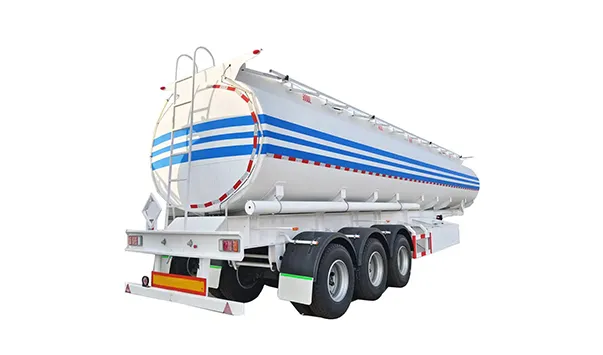
A remolque cisterna para combustible is used to haul flammable or combustible liquid products such as diesel, gasoline, aviation fuels, and other petroleum products. In U.S. cargo tank practice, DOT 406 and legacy MC 306 style equipment are strongly associated with flammable liquids with low vapor pressure, and fuel distribution fleets commonly use this family of tank trailer for refined fuels.
A fuel tank trailer usually includes several compartment sections so different products can be carried in one load. That helps operators deliver multiple grades on one trip and reduce empty miles. It also improves route flexibility for distributors serving stations, depots, and fleet yards. For many fuel fleets, this is the most common of all fuel tank trailers and one of the most visible types of tanker trucks on the road.
Safety is central here. Fuel tankers may carry hazardous materials, so design details matter: roll stability, piping protection, manholes, and baffle or surge-control strategy all affect safe operation. FMCSA notes that cargo tank rollovers are among the most serious crashes for these vehicles and can lead to spill events and road closures.

How Do Chemical Tank Trailers Differ from Fuel Tankers?
Chemical tank trailers are built for a wider and often more demanding range of liquid products. Some carry aggressive chemicals, some carry solvents, and some move specialty industrial fluids. In U.S. hazmat specifications, DOT 407 and DOT 412 families are commonly associated with broader chemical service and corrosive or higher-integrity applications, while PHMSA and CFR provisions show that different hazardous liquids require different authorized cargo tank types.
This is where tank material becomes critical. A chemical tank trailer may use stainless steel, carbon steel, aluminum, or special linings depending on the product. In some specific types of service, a customer may even consider FRP or reinforced plastic solutions, though metal tanks remain common in many fleets. The right material choice depends on whether the liquid is corrosive, reactive, food-sensitive, or temperature-sensitive.
Compared with fuel tankers, chemical units often demand more from the buyer in terms of compatibility review, inspection planning, and regulatory compliance. In real fleet work, a wrong material match is not a small mistake. It can create contamination, corrosion, unloading trouble, or unsafe service life.
What Are Dry Bulk Tank Trailers and Dry Bulk Tankers?
Unlike a fuel or chemical tanker trailer, a dry bulk tank trailer carries dry materials, not free-flowing liquid. This trailer is built for powders, pellets, and other dry product such as cement, lime, resin, sugar, flour, plastic pellets, and some mineral products. Industry unloading guidance and dry bulk handling documents show that these trailers commonly work with cone or hopper-style lower sections and air-assisted transfer.
These are often called dry bulk tankers or pneumatic trailers because many of them use compressed air during unloading. The product is moved through piping into a silo or receiving system, rather than poured like fuel. Industry bulk-unloading guidance notes that large volumes of dry air may be used during unloading of dry bulk polymer transport tanks, and recommended unloading procedures for pneumatic dry bulk tankers also show air-assisted discharge through valves and cones.
For operators in construction or manufacturing, dry bulk trailers are often the best answer for dust-sensitive or high-volume bulk material handling. They are not just a different trailer shape. They are a different transfer method. That is why buyers choosing between a dump trailer and a dry bulk tank trailer should think first about site equipment, cleanliness, discharge distance, and whether they need sealed pipeline unloading.
Why Are Food-Grade Tank Trailers a Special Tank Trailer Type?
A food-grade tank trailer carries edible products, so cleanliness becomes part of the engineering. The FDA’s sanitary transportation rule requires sanitary transportation practices for human and animal food, including requirements related to transportation equipment, operations, records, and training. Food tank trailers therefore have to support hygienic cleaning, controlled handling, and contamination prevention.
This type of tanker is commonly used in the food and beverage industry for edible oil, milk, syrup, glucose, liquid sugar, wine materials, and other food-safe bulk liquids. In practice, buyers often favor stainless steel because it is durable, cleanable, and widely accepted for food contact service. The trailer may also need polished internal surfaces, dedicated hoses, and strict wash documentation between loads.
For OEM buyers and distributors, food-grade design is about more than the tank shell. The whole loading and unloading path matters: valves, seals, manholes, hoses, pumps, and even documentation flow. A good food tanker trailer requires discipline in both manufacturing and operation.
What Makes Asphalt Tankers Different from Other Tank Trailers?
Asphalt tankers are built for hot, heavy product that behaves very differently from diesel or water-like chemical liquid. The key challenge is temperature retention and controlled discharge. Because asphalt and bitumen become much harder to move as temperature drops, the tank trailer often needs to insulate the shell and may use heating-related accessories or temperature-preserving design. Federal hazmat rulemaking around cargo tanks even notes that DOT 406, 407, and 412 cargo tanks may be used in contexts where the cargo tank can be used to transport asphalt.
This makes the trailer more specialized than many first-time buyers expect. With fuel, the main issue may be compartment delivery and vapor control. With asphalt, the main issue is keeping the product flowable and making sure the unload process is safe and efficient. The heavier product also changes center of gravity behavior, temperature planning, and cleaning requirements.
From a project perspective, asphalt tankers are a good example of why one type of tanker cannot be used for every job. The right tank trailer is always tied to the product’s real behavior, not just to the idea of “liquid transport.”
What Type of Tanker Is Used for Gas, LPG, or Other Pressurized Cargo?
When the cargo is propane, LPG, or another compressed or liquefied gas, the tanker trailer must be built as a pressure-rated unit. In U.S. regulation, PHMSA states that MC 331 is a cargo tank motor vehicle primarily for transportation of compressed gases, and eCFR rules for compressed gases in cargo tanks cross-reference the relevant hazmat preparation and inspection requirements.
This category is different from standard fuel tankers and many chemical units because the tank is carrying pressure as well as product. That is why design items such as shell strength, pressure relief valves, piping protection, and valve system integrity matter so much. PHMSA interpretations and cargo tank inspection rules also show that these units are subject to detailed testing and qualification requirements.
For operators carrying LPG or industrial gas, a gas tank trailer is one of the most specialized trailers in the fleet. It is also one of the areas where buyers should be most careful about specification, exporter experience, and after-sales technical support.

How Do Baffle, Compartment, Material, and Unload Design Affect Safety?
A baffle helps control surge inside the tank when a partially filled tanker is braking, turning, or changing speed. NTSB’s cargo tank rollover report describes transverse baffles that divided the interior volume and helped minimize the longitudinal surge of liquid in the tank. In simple words, baffles work like internal dividers with holes that reduce front-to-back surge rather than completely blocking flow.
A compartment serves a related but different purpose. A compartment lets the operator separate different liquid products or split delivery volumes. This is very common in fuel tanker trailer design. Material choice matters too. Stainless steel may be ideal for food or selected chemical service. Carbon steel may be a strong fit for some petroleum or dry bulk jobs, depending on product compatibility and corrosion risk.
The unload system also changes the trailer design. Some tank trailers are designed for gravity discharge. Some use pumps. Some dry bulk tank trailers use air pressure. Some gas or specialty units require protected piping, pressure control, or sealed transfer procedures. The right answer always depends on the real type of fuel, product viscosity, site connection, and operating routine.
How Should You Approach Choosing the Right Tank Trailer for Your Business?
Choosing the right tank trailer starts with the type of cargo. Ask four questions first. Is the product a free-flowing liquid, a hot product like asphalt, a pressurized gas, or a powder that needs pneumatic discharge? Is it corrosive, sanitary, or hazardous? Does the site need pump unload, gravity, or air discharge? And what compliance regime applies in the destination market?
Here is a practical buyer table:
| Buying question |
Por qué es importante |
| What product will you transport? |
Decides the basic type of tanker |
| Is the product hazardous or food-grade? |
Changes tank material and compliance |
| How will you unload? |
Decides pump, gravity, or neumático setup |
| What road and route conditions matter? |
Influences axle, suspension, and stability |
| Will you carry one product or many? |
May require compartimento design |
| Do you need insulation or heating? |
Important for asphalt and some chemicals |
You should also think about life-cycle cost, not just purchase price. A cheaper used tanker can look attractive, but requalification, corrosion history, or export mismatch can turn it into a poor investment. In the U.S., cargo tanks carrying regulated materials are subject to qualification and periodic inspection requirements under 49 CFR Part 180, which is a strong reminder that compliance and maintenance matter just as much as the first quote.
As a manufacturer, we always tell customers this: do not just choose the right trailer for the product you carry today. Choose the tank trailer that supports your routes, unloading sites, fleet plan, and long-term business model.
FAQs About Different Types of Tanker Trailers
What are the most common types of tanker trailers?
The most common types are fuel tankers, chemical tank trailers, food-grade tank trailers, dry bulk tank trailers, asphalt tankers, and gas tankers for compressed or liquefied gases. Different cargo tank families are recognized in regulation through DOT and MC specifications such as DOT 406, DOT 407, DOT 412, and MC 331.
What is the difference between a tanker truck and a tanker trailer?
A tanker truck has the tank mounted directly on the truck chassis. A tanker trailer is a separate semitrailer pulled by a tractor. The trailer format is often preferred for higher-capacity long-haul and fleet operations.
What are dry bulk tankers used for?
Dry bulk tankers are used for powders, pellets, and other non-liquid bulk products such as cement, lime, resin, and food powders. Many use air-assisted or pneumatic unloading systems.
Why do fuel tankers use baffles or compartments?
A baffle reduces liquid surge inside the tank, while a compartment lets the operator separate products or delivery volumes. Both features improve control and operational flexibility.
What kind of tanker is used for propane or compressed gas?
Pressure-rated gas tankers are commonly built to MC 331 style requirements for transportation of compressed gases. These trailers require pressure-related safety features and regulated inspection routines.
How do I choose the right tank trailer?
Start with the product: liquid, gas, dry bulk, food-grade, or hot bitumen. Then match the tank material, unloading method, capacity, and compliance standard to that job. That is the safest way to approach choosing the right tank trailer.
Final Thoughts: How to Choose a Tank Trailer That Fits Your Cargo
The different types of tanker trailers exist for one reason: one trailer cannot safely or efficiently carry every product. A fuel tank trailer is not a dry bulk unit. A food-grade tanker is not an asphalt carrier. A gas tank trailer is not a standard fuel hauler. Each one is built around the product’s real behavior.
For fleet owners, importers, project contractors, and distributors, that means product matching is everything. Think about cargo, discharge method, road conditions, cleaning standards, and compliance before you decide on a design. The better the match, the better the service life, safety, and operating result.
As a China-based semi trailer manufacturer, we see the best results when customers choose a tank trailer as part of a full transport solution, not as a standalone shell. The right tanker trailer should fit your product, your route, your yard, and your business plan.
Conclusiones clave
The main different types of tanker trailers include fuel, chemical, food-grade, dry bulk, asphalt, and gas tankers.
A tanker trailer is different from a tanker truck because the tank is mounted on a semitrailer rather than directly on the truck chassis.
Fuel tankers are widely used for gasoline, diesel, and other petroleum products.
Dry bulk tank trailers often use air-assisted or pneumatic unloading for powders and pellets.
Food-grade tankers must support sanitary transportation practices.
MC 331 cargo tanks are primarily for compressed gases.
A baffle helps reduce surge, while a compartment helps separate products and delivery volumes.
The best way to choose the right trailer is to match the trailer design to the type of cargo, unloading method, and compliance needs.



 14 de abril de 2026